
PG&E Solar Savings Guide: Plug-In Solar
Updated: Jul 26
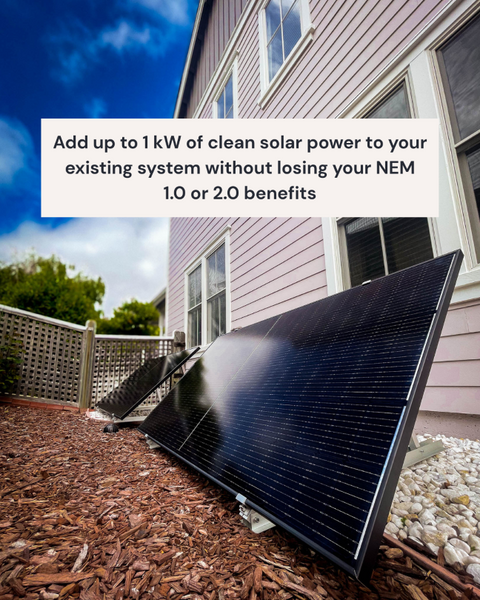
PG&E customers on NEM 1.0 or NEM 2.0 can expand their solar system by up to 1 kW without losing their existing NEM rate. For full details, see our guide to NEM expansion rules in California. At Northern California NEM rates (~$0.30/kWh), a plug-in expansion kit earns $360 to $660 per year in net metering credits.
PG&E Solar Savings Guide: How Plug-In Solar Cuts Your Electric Bill
In short: PG&E NEM customers can add a plug-in solar expansion kit and earn $360-$660/year in net metering credits at NEM rates of ~$0.30/kWh. A 2-panel kit ($1,649 with tax) pays for itself in 4.6 years. A 4-panel kit ($2,583) pays back in 3.9 years.
Your rooftop solar was sized for your energy needs when you installed it. But things change. You got an EV. You added a heat pump. Your family grew. Now your true-up bill is creeping back up.
The traditional fix — calling your installer back out — means permits, scheduling, and $3,000 to $5,000 for a small add-on. Some installers won't even take the job.
See also: How Plug-In Solar Works | Plug-In vs. Traditional | EV Charging Offset
Bright Saver's NEM Expansion Kit gives you another option. Add 2 or 4 panels in your backyard, do a little Ikea-style assembly, plug into a standard outlet, and start earning more NEM credits the same day.
How NEM Expansion Works with PG&E
If you're on NEM 1.0 or NEM 2.0, PG&E's published tariff allows you to expand your solar generating capacity by up to 1 kW or 10% of your original system size (whichever is greater) without losing your existing net metering rate.
Your plug-in panels generate electricity that flows into your home. When your home is using less than the panels produce, the excess flows back through your existing bi-directional meter to the grid — earning you NEM credits at your existing NEM rate, just like your rooftop panels.
Savings for PG&E Customers
At Northern California NEM rates (~$0.30/kWh), each panel earns approximately $180/year in net metering credits.
System | Price + Tax* | Annual NEM Credits | Payback Period |
NEM 2-Panel | $1,649 | $360/year | 4.6 years |
NEM 4-Panel | $2,583 | $660/year | 3.9 years |
*Includes 10% estimated sales tax.
The 4-panel system has a shorter payback because the third and fourth panels add production at a lower incremental cost, even though the 900W inverter clips peak output for a few hours on the sunniest days. Annual energy lost to clipping is only about 10%.
PG&E's New Base Services Charge
Starting March 2026, PG&E is rolling out a ~$24/month flat Base Services Charge for all residential customers. This is a fixed monthly fee that shows up on every bill regardless of how much electricity you use — or how much solar you generate.
Here's the critical detail: you cannot offset the Base Services Charge with solar production. NEM credits reduce your volumetric energy charges (the per-kWh portion of your bill), but the Base Services Charge sits outside that calculation entirely. Whether you have a 10 kW rooftop system or no solar at all, you pay the same ~$24/month.
For PG&E solar customers, this means your annual electric bill now has a ~$288 floor that solar can never touch. Before this charge, a well-sized solar system could bring a PG&E bill close to zero. That's no longer possible.
What does this mean for plug-in solar expansion? It actually makes NEM credits more important, not less. The Base Services Charge eats into the savings your rooftop system provides, which means many NEM customers will see higher true-up bills than expected. Adding an expansion kit helps claw back those savings by generating more credits against the energy charges that solar can offset.
Think of it this way: PG&E just raised your fixed costs by $288/year. A 2-panel expansion kit generates $360/year in NEM credits. That more than covers the new charge and then some.
PG&E Rate Plans for Solar Customers
PG&E offers two main time-of-use rate plans for residential solar customers: E-TOU-C and E-TOU-D. Which plan you're on affects the value of every kWh your panels produce.
E-TOU-C (the default for most solar customers):
Peak hours: 4:00 PM to 9:00 PM daily
Off-peak hours: all other hours
Peak rates run roughly $0.45-$0.55/kWh in summer
Off-peak rates run roughly $0.30-$0.38/kWh
E-TOU-D (optional, more aggressive time split):
Peak hours: 5:00 PM to 8:00 PM daily
Off-peak hours: all other hours
Higher peak rates (roughly $0.50-$0.60/kWh in summer)
Lower off-peak rates (roughly $0.27-$0.34/kWh)
Most PG&E solar customers find that E-TOU-C works best because the longer peak window (4-9 PM) aligns better with typical household usage patterns. Check your PG&E account online to see which plan you're currently on and model a switch.
Bay Area vs Central Valley Production
Not all PG&E territory is created equal when it comes to solar production. Northern California's geography creates significant regional differences.
Bay Area (San Francisco, Peninsula, parts of East Bay):
4.5 to 5.0 peak sun hours/day on average
Summer fog along the coast and through the Golden Gate reduces morning production significantly from June through August
The fog belt is worst in the Sunset, Richmond, Daly City, and Pacifica — expect 10-15% less annual production than inland areas
Microclimates matter: a home in Walnut Creek or Pleasanton gets meaningfully more sun than one in San Mateo
Central Valley (Sacramento, Stockton, Fresno, Bakersfield):
5.5 to 6.0 peak sun hours/day on average
Hot, dry summers with minimal cloud cover mean peak production stretches from April through October
Sacramento-area homes routinely see 15-20% more annual solar production than San Francisco-area homes
The tradeoff: higher AC usage in summer means more self-consumption, which saves at the full retail rate
North Bay and Wine Country (Santa Rosa, Napa, Petaluma):
5.0 to 5.5 peak sun hours/day
Less fog than the coast, but winter rains reduce November-February production
Solid middle ground for solar production
What this means practically: a 4-panel expansion kit in Fresno might produce $720/year in credits versus $620/year in San Francisco. Both are excellent returns, but if you're in the Central Valley, your payback period could be closer to 3.5 years instead of 4.
Why the Math Gets Better Over Time
California electricity rates have been rising 5 to 8% per year consistently. Your NEM credits grow as rates increase, but your kit cost is locked in at day one.
Year | Est. NEM Rate | 2-Panel Annual Credits | 4-Panel Annual Credits |
Year 1 | $0.30/kWh | $360 | $660 |
Year 5 | $0.37/kWh | $444 | $814 |
Year 10 | $0.47/kWh | $564 | $1,034 |
Year 20 | $0.76/kWh | $912 | $1,672 |
Over 20 years, a 2-panel kit generates over $11,000 in cumulative NEM credits on a $1,649 investment. A 4-panel kit generates over $21,000 on a $2,583 investment.
What About Self-Consumption?
When your home is using more electricity than your panels are producing (which is common during high-use periods), the solar energy gets consumed directly. In that case, you're saving at your full retail rate (~$0.42/kWh), which is even higher than the NEM credit rate. Either way — credits or self-consumption — you save.
PG&E Interconnection: No New Application Needed
One of the biggest advantages of expanding within PG&E's published limits is the simplified interconnection process. For rooftop solar additions, you'd normally need to submit a new interconnection application, wait for engineering review, schedule inspections, and receive a new Permission to Operate (PTO). That process can take weeks to months.
With a plug-in NEM expansion kit that stays within the 1 kW or 10% threshold, PG&E does not require a new interconnection application. PG&E references this expansion allowance in their NEM2 Sunset FAQ documentation. You're working within your existing interconnection agreement and your existing bi-directional meter.
Here's what that means in practice:
No new application to PG&E. You don't need to submit paperwork or wait for approval.
No engineering review. PG&E doesn't need to evaluate your panel or service capacity for small expansions within the published limits.
No inspection scheduling. No waiting for a city inspector or PG&E field visit.
No new PTO. Your existing Permission to Operate covers the expansion.
Same-day production. Plug in your kit and it starts generating credits immediately under your existing NEM agreement.
This is a major differentiator from traditional solar add-ons, where the interconnection timeline alone can stretch 4 to 8 weeks even for a simple 1-2 panel addition.
FAQ
Can I really just plug this into an outlet?
Yes. The microinverter converts DC solar power to standard 120V AC. It includes automatic anti-islanding protection that shuts the system off the moment the grid goes down, the same safety behavior used in grid-connected rooftop systems.
Will this affect my NEM 2.0 rate?
No. PG&E's published tariff allows capacity expansion of up to 1 kW or 10% of your original system size without losing your existing NEM rate.
What if I produce more than I use?
Excess flows back through your meter and earns NEM credits, just like your rooftop panels. That's the whole point of the NEM Expansion Kit.
How does this compare to calling my installer back?
A traditional 1-2 panel add-on costs $3,000 to $5,000, takes weeks to months, and requires permits and inspections. A plug-in kit costs $1,649, installs in an afternoon, and starts producing immediately.
Does the Base Services Charge change my solar savings?
The ~$24/month charge can't be offset by solar, but it doesn't reduce the value of NEM credits. Every kWh your expansion kit produces still earns credits at your NEM rate against your energy charges.
Stop overpaying PG&E. A Bright Saver NEM Expansion Kit pays for itself in under 5 years, then keeps earning credits for 15+ more years.
NEM 2-Panel Kit: $1,499 (+ tax)
NEM 4-Panel Kit: $2,348 (+ tax)
Free pickup from our Oakland or Los Angeles warehouses. Delivery + installation support available within 50 miles of Oakland for $349.
Bright Saver is a 501(c)(3) nonprofit. Our mission: Help Americans save on electricity bills by making plug-in solar affordable and accessible to all.