
SCE Solar Savings: Plug-In Solar Guide
Updated: Jul 26
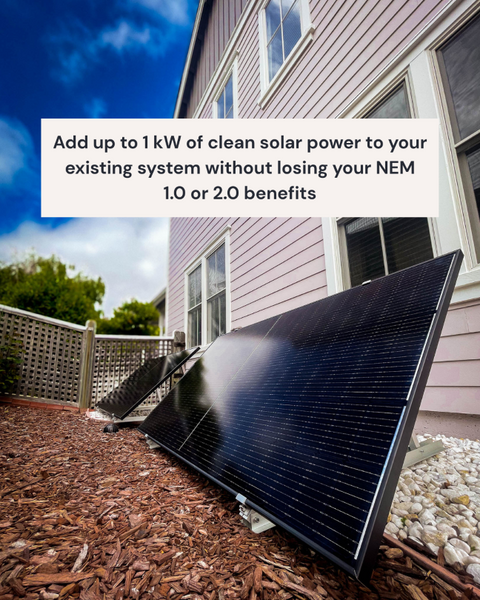
SCE customers on NEM 1.0 or NEM 2.0 can expand their solar system by up to 1 kW without losing their existing NEM rate. For full details, see our guide to NEM expansion rules in California. Southern California's abundant sunshine makes plug-in solar one of the best returns on investment available.
SCE Solar Savings Guide: Plug-In Solar for Southern California Edison Customers
In short: SCE NEM customers can add a plug-in solar expansion kit and earn $384-$704/year in net metering credits at SCE NEM rates of ~$0.32/kWh. A 2-panel kit pays for itself in 4.3 years, and a 4-panel kit in 3.7 years.
SCE residential rates average about 34.5 cents/kWh as of early 2026, with TOU peak rates reaching over 50 cents/kWh in summer. If you already have rooftop solar on NEM 1.0 or NEM 2.0, your exported electricity earns credits at or near those retail rates — far more valuable than the ~$0.08/kWh that new NEM 3.0 customers receive.
That existing NEM rate is worth protecting. And expanding.
See also: How Plug-In Solar Works | Plug-In vs. Traditional | EV Charging Offset
How NEM Expansion Works with SCE
SCE's published tariff allows NEM 1.0 and NEM 2.0 customers to expand their solar generating capacity by up to 1 kW or 10% of the original system size (whichever is greater) without losing their existing net metering rate.
Bright Saver's NEM Expansion Kit lets you add 2 or 4 panels in your backyard. A little Ikea-style assembly, plug into a standard outlet, and start earning more NEM credits the same day. No contractor. No permits. No changes to your NEM agreement.
When your home is using less than the panels produce, the excess flows back through your existing bi-directional meter to the grid — earning you NEM credits at your existing NEM rate, just like your rooftop panels.
Savings for SCE Customers
At SCE NEM rates (~$0.32/kWh), each panel earns approximately $192/year in net metering credits. Southern California's extra sunshine means slightly higher production than Northern California.
System | Price + Tax* | Annual NEM Credits | Payback Period |
NEM 2-Panel | $1,649 | $384/year | 4.3 years |
NEM 4-Panel | $2,583 | $704/year | 3.7 years |
Includes 10% estimated sales tax.
The 4-panel system has a shorter payback because the third and fourth panels add production at a lower incremental cost, even though the 900W inverter clips peak output for a few hours on the sunniest days. Annual energy lost to clipping is only about 10%.
SCE Rate Plans and TOU Periods
Understanding SCE's time-of-use structure is key to maximizing your plug-in solar value. SCE offers several TOU plans, but two matter most for solar customers:
TOU-D-PRIME (the recommended solar plan):
Peak hours: 4:00 PM to 9:00 PM weekdays
Off-peak: 9:00 PM to 8:00 AM weekdays, all weekend hours
Super off-peak: 8:00 AM to 4:00 PM weekdays (this is when solar produces most)
Summer peak rates: ~$0.50-$0.55/kWh
Super off-peak: ~$0.18-$0.22/kWh
This plan has the biggest spread between peak and off-peak
TOU-D-4 (the default residential TOU plan):
Peak hours: 4:00 PM to 9:00 PM weekdays
Off-peak: all other hours
More moderate rate spread than TOU-D-PRIME
Summer peak: ~$0.42-$0.48/kWh
Community Choice Aggregators in SCE Territory
If you're in SCE territory, there's a good chance you're actually buying your electricity generation from a Community Choice Aggregator (CCA) rather than directly from SCE. The largest CCA in SCE territory is Clean Power Alliance (CPA), which serves over 3 million customers across 32 cities and unincorporated LA County.
Here's how it works and why it matters for plug-in solar:
The billing split: Even if you're a CPA customer, SCE still handles your delivery charges (transmission, distribution, grid maintenance). CPA handles your generation charges. Your bill comes from SCE with both components.
How NEM credits apply: Your NEM credits offset both the generation and delivery portions of your bill. Whether your generation comes from CPA, SCE, or another CCA, the NEM credit calculation works the same way. Your bi-directional meter tracks net energy flow regardless of who supplies the generation.
CCA rates vs SCE rates: CPA's default rate (100% renewable) is typically within $0.01-$0.02/kWh of SCE's generation rate. Some CCAs offer slightly lower rates, which can marginally affect your NEM credit value — but the difference is small enough that it shouldn't change your expansion decision.
Other CCAs in SCE territory: Besides Clean Power Alliance, you may be served by Lancaster Choice Energy, Pico Rivera Innovative Municipal Energy, or Apple Valley Choice Energy, among others. Check your bill or contact your city to confirm.
Bottom line: CCA membership doesn't change the value of plug-in solar expansion. Your NEM agreement stays with SCE regardless of your generation provider.
Southern California Regional Production
Southern California gets significantly more sun than the state average, but there's meaningful variation across the region.
Inland Empire (Riverside, San Bernardino, Ontario, Rancho Cucamonga):
5.8 to 6.2 peak sun hours/day
Hot, clear summers with minimal marine layer
Among the highest solar production in all of SCE territory
Tradeoff: extreme summer heat (100°F+) increases AC usage, which means more self-consumption at full retail rate — actually a benefit since retail rates are higher than NEM credit rates
Expected annual production from a 4-panel kit: ~2,400 kWh ($768/year at $0.32/kWh)
San Gabriel Valley (Pasadena, Arcadia, Monrovia, Azusa):
5.5 to 5.8 peak sun hours/day
Generally clear, but occasional June Gloom marine layer pushes inland
Solid production year-round with less extreme heat than Inland Empire
Orange County Coast (Huntington Beach, Newport, Laguna):
5.2 to 5.5 peak sun hours/day
Marine layer affects mornings, especially May through July
Afternoon burn-off means good production from noon onward
Slightly lower annual production than inland, but still excellent
LA Basin (Downtown LA, Hollywood, Mid-Wilshire):
5.3 to 5.7 peak sun hours/day
Air quality can slightly reduce production on high-smog days
Generally strong production with less marine layer than the coast
What this means for your payback: an Inland Empire homeowner with a 4-panel kit might see payback in 3.4 years versus 3.9 years on the Orange County coast. Both are excellent, but the inland advantage is real.
Why the Math Gets Better Over Time
California electricity rates have been rising 5 to 8% per year. Your NEM credits grow as rates increase, but your kit cost is locked in at day one.
Year | Est. NEM Rate | 2-Panel Annual Credits | 4-Panel Annual Credits |
Year 1 | $0.32/kWh | $384 | $704 |
Year 5 | $0.39/kWh | $468 | $858 |
Year 10 | $0.50/kWh | $600 | $1,100 |
Year 20 | $0.81/kWh | $972 | $1,782 |
Over 20 years, a 2-panel kit generates over $12,000 in cumulative NEM credits on a $1,649 investment. A 4-panel kit generates over $23,000 on a $2,583 investment.
Self-Consumption vs. NEM Credits
When your home is using more electricity than your panels produce (common during high-use periods, especially Inland Empire summers), the solar energy gets consumed directly. In that case, you're saving at your full retail rate (~$0.345/kWh or higher during peak TOU periods), which may be even higher than your NEM credit rate. Either way — credits or self-consumption — you save.
SCE Interconnection: What to Expect
SCE's interconnection process for NEM expansions differs from PG&E's in one important way: SCE requires an interconnection review before granting Permission to Operate (PTO) for system modifications, even for small expansions within the 1 kW / 10% threshold.
Here's what the process typically looks like:
Submit a modification request through SCE's online interconnection portal or by contacting SCE directly
Engineering review — SCE reviews your existing system specs and the proposed expansion to confirm it stays within the NEM expansion limits
Approval and updated PTO — once approved, SCE issues an updated Permission to Operate reflecting the additional capacity
Timeline: The review typically takes 2 to 4 weeks, though processing times can vary depending on SCE's backlog
Important: You should submit the modification request before plugging in your expansion kit, or at the time of installation. While the technical risk of plugging in immediately is minimal (the system uses UL 1741 SB certified equipment with anti-islanding protection), SCE's tariff requires the review to be completed for formal compliance.
This is more paperwork than PG&E requires (PG&E doesn't need a new application for small expansions), but it's still far simpler and faster than a full interconnection for a traditional rooftop add-on, which can take 6 to 12 weeks.
FAQ
Will this affect my NEM 2.0 rate?
No. SCE's published tariff allows capacity expansion of up to 1 kW or 10% of your original system size without losing your existing NEM rate.
What if I produce more than I use?
Excess flows back through your meter and earns NEM credits, just like your rooftop panels.
Do I need SCE's permission?
SCE requires an interconnection review for system modifications. Contact SCE or use their online portal. Typical processing time is 2 to 4 weeks.
I'm with Clean Power Alliance. Does this still work?
Yes. Your NEM agreement is with SCE regardless of your generation provider. CCA membership doesn't change how NEM credits work.
How does TOU-D-PRIME affect my savings?
Your panels generate during super off-peak hours and the credits offset peak-hour consumption at true-up. The rate spread actually benefits solar customers.
SCE rates keep climbing. Your NEM rate is a locked-in asset — put it to work.
NEM 2-Panel Kit: $1,499 (+ tax)
NEM 4-Panel Kit: $2,348 (+ tax)
Free pickup from our Oakland or Los Angeles warehouses. Delivery + installation support available within 50 miles of Oakland for $349.
Bright Saver is a 501(c)(3) nonprofit. Our mission: Help Americans save on electricity bills by making plug-in solar affordable and accessible to all.