
SDG&E Solar Guide: Plug-In Solar Savings
Updated: Jul 26
SDG&E charges roughly 2.7x the national average for electricity. If you're on NEM 1.0 or NEM 2.0, your existing NEM rate is one of the most valuable assets on your property. A plug-in NEM expansion kit puts it to work.
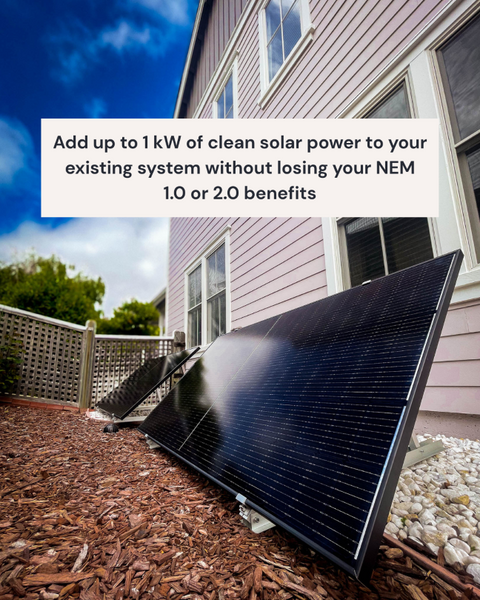
SDG&E Solar Guide: Why San Diego Homeowners Are Adding Plug-In Solar
In short: SDG&E has the highest electricity rates of any major California utility (~$0.36/kWh NEM rate). A plug-in solar expansion kit earns $432-$792/year in NEM credits, paying for itself in 3.3-3.8 years — the fastest payback in the state.
San Diego: one of the sunniest cities in America, one of the most expensive electricity providers. SDG&E's bundled residential rate hit ~45.7 cents/kWh in early 2026, with TOU peak rates reaching 55 to 70 cents/kWh.
If you already have rooftop solar on NEM 1.0 or NEM 2.0, your exported electricity earns credits at or near those retail rates. That's an incredible deal compared to the ~$0.08/kWh that new NEM 3.0 customers receive. Every additional kWh you generate is worth real money.
See also: How Plug-In Solar Works | Plug-In vs. Traditional | EV Charging Offset
How NEM Expansion Works with SDG&E
SDG&E's published tariff allows NEM 1.0 and NEM 2.0 customers to expand their solar generating capacity by up to 1 kW or 10% of the original system size (whichever is greater) without losing their existing net metering rate.
Bright Saver's NEM Expansion Kit lets you add 2 or 4 panels in your backyard. A little Ikea-style assembly, plug into a standard outlet, and start earning more NEM credits the same day. No contractor. No permits. No changes to your NEM agreement.
Savings for SDG&E Customers
SDG&E NEM credit rates are the highest of any major California utility at approximately ~$0.36/kWh. Each panel earns roughly $216/year in net metering credits. San Diego's sunshine pushes production even higher.
System | Price + Tax* | Annual NEM Credits | Payback Period |
NEM 2-Panel | $1,649 | $432/year | 3.8 years |
NEM 4-Panel | $2,583 | $792/year | 3.3 years |
Includes 10% estimated sales tax.
A 4-panel kit pays for itself in about 3 years in San Diego. Then it keeps earning for 22+ more.
Why SDG&E Rates Are the Highest in California
San Diego homeowners often wonder why they pay so much more than the rest of the state. The short answer: infrastructure costs, wildfire liability, and rate structure design.
SDG&E has invested billions in wildfire prevention infrastructure — undergrounding power lines, installing weather stations, upgrading grid equipment — after the devastating 2003 and 2007 wildfires. Those costs get passed to ratepayers. Additionally, SDG&E has a smaller customer base than PG&E or SCE, so fixed infrastructure costs get spread across fewer households.
SDG&E's TOU-DR1 rate plan (the default for most residential customers):
On-peak: 4:00 PM to 9:00 PM daily
Off-peak: 6:00 AM to 4:00 PM and 9:00 PM to midnight
Super off-peak: midnight to 6:00 AM
Summer on-peak rates: $0.55 to $0.70/kWh — among the highest in the nation
Summer off-peak: ~$0.35-$0.42/kWh
Winter rates are lower but still well above the national average
The bottom line: SDG&E customers have the strongest financial case for plug-in solar expansion of anyone in California. Higher rates = faster payback = more lifetime savings.
San Diego Community Power: What It Means for Your Solar
As of 2026, over 60% of SDG&E residential customers have been automatically enrolled in San Diego Community Power (SDCP), the region's Community Choice Aggregator. If you haven't actively opted out, you're likely an SDCP customer.
Here's what that means — and doesn't mean — for plug-in solar:
How the billing works: Your electricity bill still comes from SDG&E, but it now has two components:
Generation charges from SDCP (the cost of the electricity itself)
Delivery charges from SDG&E (transmission, distribution, grid maintenance)
SDCP's default plan is Power100 (100% renewable), priced to be competitive with SDG&E's bundled generation rate. Most customers see little or no change in their total bill after enrollment.
How NEM credits work with SDCP: Your NEM agreement is with SDG&E, not SDCP. Your bi-directional meter tracks net energy flow exactly as before. NEM credits offset both generation and delivery charges. Whether your generation comes from SDCP or SDG&E doesn't change the credit calculation.
Can I opt out of SDCP? Yes, you can return to SDG&E bundled service at any time. But for most solar customers, SDCP's rates are comparable and the 100% renewable default is a bonus. Opting out doesn't change your NEM credits.
SDCP vs SDG&E rate comparison: SDCP's effective generation rate is within ~$0.005/kWh of SDG&E's in most cases. The difference is negligible for NEM credit purposes.
Bottom line: SDCP enrollment doesn't affect your plug-in solar decision at all. Your NEM rate, your meter, your credits — all unchanged.
San Diego Microclimate Solar Production
San Diego County has some of the best solar resources in California, but production varies meaningfully by location due to coastal microclimates.
Inland San Diego (El Cajon, Escondido, Ramona, Poway):
5.8 to 6.2 peak sun hours/day
Clear, hot summers with minimal marine influence
Highest solar production in the county
A 4-panel kit here produces approximately 2,400 kWh/year ($864/year at $0.36/kWh)
Payback: as fast as 3.0 years for inland locations
Coastal San Diego (La Jolla, Encinitas, Del Mar, Carlsbad):
5.4 to 5.8 peak sun hours/day
Morning marine layer ("May Gray" / "June Gloom") reduces production in late spring and early summer
Marine layer typically burns off by noon, so afternoon production is strong
A 4-panel kit here produces approximately 2,100 kWh/year ($756/year at $0.36/kWh)
North County Inland (Vista, San Marcos, Fallbrook):
5.5 to 5.9 peak sun hours/day
Less marine influence than the coast, cooler than deep inland
Excellent solar production with comfortable temperatures
Sweet spot for panel efficiency (cooler temps = slightly higher output per panel)
South Bay (Chula Vista, National City, Imperial Beach):
5.5 to 5.8 peak sun hours/day
Similar to coastal, with some morning marine layer
Proximity to LA warehouse makes pickup convenient
Pro tip for panel placement: In coastal San Diego, west-facing panels can outperform south-facing panels in summer because they capture strong afternoon sun after the marine layer burns off. If your backyard faces west, that's actually an advantage.
Why the Math Gets Better Over Time
SDG&E rates have been among the most aggressive in the state. Your NEM credits grow as rates increase, but your kit cost is locked in at day one.
Year | Est. NEM Rate | 2-Panel Annual Credits | 4-Panel Annual Credits |
Year 1 | $0.36/kWh | $432 | $792 |
Year 5 | $0.44/kWh | $528 | $968 |
Year 10 | $0.56/kWh | $672 | $1,232 |
Year 20 | $0.91/kWh | $1,092 | $2,002 |
Over 20 years, a 2-panel kit generates over $14,000 in cumulative NEM credits on a $1,649 investment. A 4-panel kit generates over $26,000 on a $2,583 investment.
Self-Consumption vs. NEM Credits
When your home is using more electricity than your panels produce (common during high-use periods), the solar energy gets consumed directly. In that case, you're saving at your full retail rate (~$0.457/kWh or higher during peak TOU periods). Either way — credits or self-consumption — you save.
SDG&E Solar Application Portal
SDG&E follows the same CPUC expansion rule — NEM 1.0 and NEM 2.0 customers can add up to 1 kW or 10% without losing their existing NEM rate. Like SCE, SDG&E requires a modification request for changes to an existing NEM system.
Here's what the process looks like:
Log in to SDG&E's Solar Application Portal at sdge.com/solar-application
Select "Modify Existing System" and enter your existing NEM agreement number
Provide expansion details — system size increase (800W for 2-panel, 900W for 4-panel), equipment specs (microinverter model, panel specs)
SDG&E reviews the modification to confirm it stays within the 1 kW / 10% expansion threshold
Updated PTO — SDG&E issues an updated Permission to Operate
Timeline: Typically 2 to 4 weeks for the review, though simple modifications within published limits are usually processed faster
Note: This is a registration process, not a new interconnection application. The review is significantly simpler and faster than a full interconnection for a traditional add-on. SDG&E is confirming your expansion stays within the rules, not re-engineering your service.
FAQ
Will this affect my NEM 2.0 rate?
No. SDG&E's published tariff allows capacity expansion of up to 1 kW or 10% of your original system size without losing your existing NEM rate.
What if I produce more than I use?
Excess flows back through your meter and earns NEM credits at your existing NEM rate, just like your rooftop panels.
I'm enrolled in San Diego Community Power. Does that matter?
No. Your NEM agreement is with SDG&E regardless of your generation provider. SDCP enrollment doesn't change how credits work.
Do I need SDG&E's permission?
SDG&E requires a modification request through their Solar Application Portal. It's a registration process, not a full interconnection. Typical processing: 2 to 4 weeks.
How does this compare to calling my installer back?
A traditional 1-2 panel add-on costs $3,000 to $5,000, takes weeks to months, and requires permits and inspections. A plug-in kit costs $1,649, does some Ikea-style assembly, and starts producing the same day.
Why is my payback faster than PG&E or SCE customers?
SDG&E's NEM credit rate (~$0.36/kWh) is the highest of any major California utility. Higher rate = more dollars per kWh = faster payback.
SDG&E charges the highest rates in California. Don't just accept it — put your NEM rate to work.
NEM 2-Panel Kit: $1,499 (+ tax)
NEM 4-Panel Kit: $2,348 (+ tax)
Free pickup from our Oakland or Los Angeles warehouses. Delivery + installation support available within 50 miles of Oakland for $349.
Bright Saver is a 501(c)(3) nonprofit. Our mission: Help Americans save on electricity bills by making plug-in solar affordable and accessible to all.